Longer backup and a higher production peak create different expansion requirements. A growing business may need more stored energy without increasing its simultaneous load, or more conversion power without extending its operating period. Battery cabinets and containers introduce different energy increments into a staged expansion plan. The physical size of an added unit describes its packaging, while the electrical design determines how its capacity can contribute to the expanding installation.
Separating the Two Directions of Growth
Expansion can address the power required at a particular time, the energy required over a period, or both. An additional production line may increase simultaneous demand, while longer operating hours may mainly increase energy consumption. The original load profile therefore needs updating before the expansion is expressed as a number of additional units.
For commercial energy storage systems, adding battery energy does not automatically raise the AC power available to the load. The power conversion equipment remains a separate constraint. Conversely, a larger converter does not create more stored energy, so an expanded output capability can consume the available reserve more quickly when operated at higher power.
The required reserve also belongs in the growth calculation. Capacity assigned to backup may be unavailable for routine energy shifting, depending on the operating strategy. A future operating schedule must distinguish these duties before deciding whether the next investment primarily addresses output, storage duration or a combination. That decision defines the expansion problem more precisely than a simple capacity multiplier.
A staged expansion plan needs to identify which equipment stays in service and which interfaces change at the next step. Existing converters, protection devices and cable routes may become constraints before enclosure space is exhausted. Recording those interfaces early makes the intended growth path explicit, rather than treating a later battery addition as an isolated purchase with no effect on the existing site electrical installation.
Understanding the Size of the Added Energy Unit
A battery cabinet and a battery container represent different boundaries for packaged energy storage. Their contents and interfaces must be identified rather than inferred from the enclosure name. A battery-only unit is not equivalent to a complete system that also includes the conversion and distribution needed to supply an AC load.
The useful expansion increment for commercial energy storage systems is therefore the usable contribution of a compatible added unit. Smaller increments may suit staged growth, while a larger packaged block changes the amount of capacity installed at one time. Neither choice is inherently correct; its suitability depends on the growth step and the supporting electrical infrastructure.
Physical planning follows the same distinction. More individual cabinets can require additional installation positions and connections, whereas a container concentrates a larger energy block in one enclosure. Transport access, foundations and maintenance space belong in the layout assessment. The nominal energy figure remains separate from the AC output that the completed station can deliver.
Comparing Cabinet and Container Reference Points
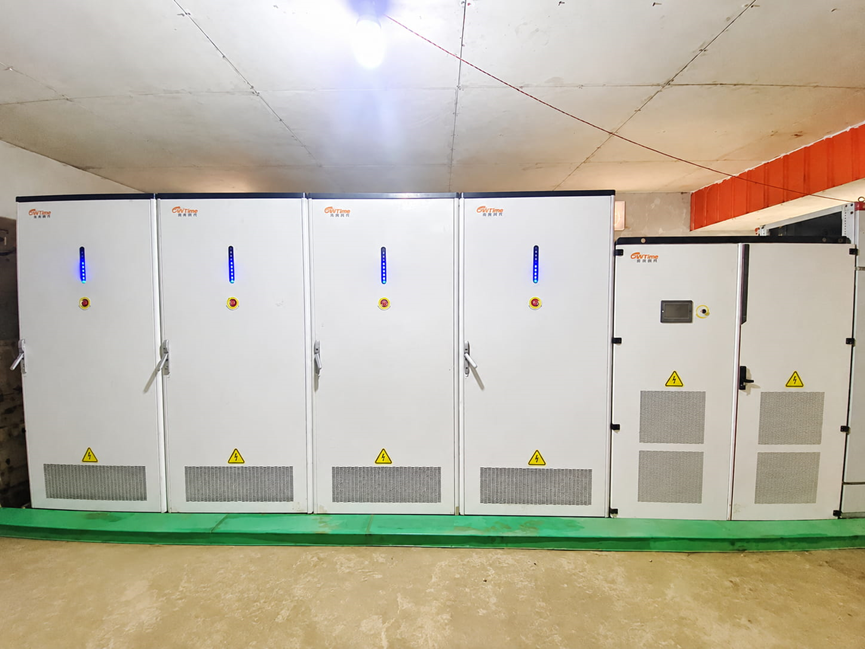
The 225 kWh and 241 kWh outdoor cabinets and the 2570 kWh and 2508 kWh containers from GWTime illustrate different packaged energy increments. The cabinet models are GWE225-400-A and GWE241-400-A, while the container models are GWE2570-400-A and GWE2508-690-A. These are nominal battery capacities, so the comparison establishes scale rather than a guaranteed operating duration.
The two cabinets share dimensions of 1050 by 1050 by 2350 mm, despite having different energy capacities. The containers measure 6058 by 2438 by 2896 mm. Those dimensions give layout planning concrete reference points, but occupied enclosure space alone does not represent the full installation area once access and supporting equipment are considered.
Energy totals also conceal electrical differences. The cabinet nominal voltages are 716.8 V and 768 V, while the two container configurations use different voltage platforms. Similar capacity does not establish interchangeable connections, and a collection of smaller units cannot be assumed to match a larger unit’s electrical arrangement merely because their energy figures can be added.
Carrying Compatibility and Maintenance into the Next Stage
Voltage matching, communications and thermal management must remain valid after an expansion. For the GWTime containers, the 1000 V-class GWE2570-400-A has an 819.2 V nominal battery voltage, whereas the 1500 V-class GWE2508-690-A has a 1331.2 V nominal value. The platform labels and nominal battery voltages describe different characteristics, so both belong in the interface assessment.
Those differing interfaces constrain how commercial energy storage systems can fit an existing station. Converter input conditions, protection arrangements and control responsibilities need checking for the proposed configuration. The design review establishes which added units need commissioning records and how those records identify the unit interfaces, keeping the original installation distinguishable from each later expansion block.
The specified GWTime battery cabinets and containers use smart air cooling and provide 4G, Wi-Fi and Ethernet connectivity. These features identify cooling and networking provisions within the packaged units, while the expanded site’s maintenance access and communications arrangement still need coordination. Adding capacity must preserve the ability to supervise and service the installation as a whole.
An expansion succeeds when its added capability addresses the growth requirement that prompted it. The relevant comparison joins the energy increment to compatible power conversion, electrical interfaces and a workable site arrangement. Once the growth requirement is defined, cabinet or container choice rests on the size of that step, electrical compatibility and practical access for ongoing maintenance.